
Introduced: 2004 (Life-Like non-DCC version), 2012 (Walthers DCC-Ready version) and 2025 (Atlas DCC-Sound version)
Life-Like's GP60 was a truly outstanding locomotive, both in terms of looks and performance. And although the original version's complete lack of DCC support was a bit disappointing for a 2004 release, Life-Like/Walthers did eventually come to their senses and release a new DCC-Ready version in 2012. Atlas acquired the tooling for the Life-Like/Walthers GP60 (among other models) in 2018 and released revised versions in 2025.

Apart from its DCC-Hostility, the original 2004 mechanism (above) sports all of the other features one normally associates with "state of the art" diesel models - IE, split-frame / all-metal chassis, five-pole / skew-wound "scale speed" motor, dual flywheels, low-friction drive, bi-directional LED lighting, all-wheel drive and pickup (no traction tires), blackened / low-profile wheels, shell-mounted Accurail automatic couplers, all-plastic gearing, etc.
As noted above, the model was redesigned in 2012 for DCC support. The dual-lightboard chassis was changed such that it could accept a full-length lightboard with motor contacts (designed such that it could be swapped out in favor of a decoder) -

In addition to the chassis/lightboard changes, the couplers were changed to Micro-Trains with this release.
Regardless of the version, these may well be the sweetest running diesels I've ever had the pleasure of operating. They're absolutely smooth and responsive, they can creep slower than the eye can detect, and the sound they generate is, well, isn't. Seriously, these things make virtually no sound whatsoever. It's almost a mystical experience watching them glide around the rails. Better still, they're terrific pullers as well. And despite Life-Like's circa-2004 neo-luddite attitude towards DCC, it's nice to see that they did finally provide support for the DCC crowd.
The packaging for the two versions is virtually identical. However, the newer DCC-Ready version has a big "Micro-Trains" sticker on the lid and says "Walthers" on the bottom of the box insert (as opposed to the first version, which has a "Life-Like Trains" logo on the bottom). As far as what decoder to use in the new version, anything designed for Life-Like's DCC-Ready GP20 will work (IE a Digitrax DN163L0A or a TCS L1D4).
As noted above, Atlas purchased the Walthers / Life-Like line of N scale models in 2018 and reissued the GP60 as part of their "Master" line in 2025 -

Although the chassis was modified to support DCC Sound, shells can be freely swapped between the old and new versions. Silver models come with an analog lightboard, whereas Gold models come with an ESU LokSound decoder (and note that there is no "DCC socket", the entire board is the decoder). Both versions come with speakers mounted inside of the fuel tank. Contacts on the board receive current from the chassis halves. LEDs provide directional lighting for the headlight, backup light and number boards. Metal contacts brush up against the bottom of the main PCB and transfer current to the motor and speaker. Gone are the chassis contact strips that the truck axle-wipers used to rub up against (an Atlas staple since the 1980's). Instead, small wires are soldered to the axle-wipers on one end and to screws in the chassis on the other. Atlas has provided channels in the chassis in which to seat the truck wires. Lighting for the ditch lights is provided by flexible light tubing that runs from the main PC board to the ditch light housings in the shell. Getting the tubes plugged back into their housings after removing the shell is (thankfully) a pretty simple procedure. Note that the ditch lights are controlled separately (by F6).
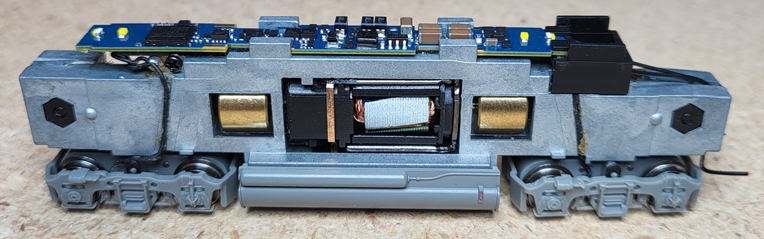
The trucks and fuel tank are unchanged from previous versions. As noted previously, the speaker mounts inside the bottom of the chassis and is held in place by the fuel tank -

As pictured below, the fuel tank sits extremely low (just barely above the rails). Consequently, if you have any sort of unevenness in your track, the fuel tank will actually skim the tops of the rails (which, depending on your specific track situation, may result in major problems or no problems at all). As pictured above, my fuel tank did wind up with a few skid marks on it, and if I were interested in running this model I'd go ahead and sand a little bit off the bottom of the tank. Speculation is that earlier releases had larger wheels (and thus more breathing room between tank and rails). Unfortunately, I no longer own a Life-Like GP60, so I can't perform a side-by-side comparison to confirm that.
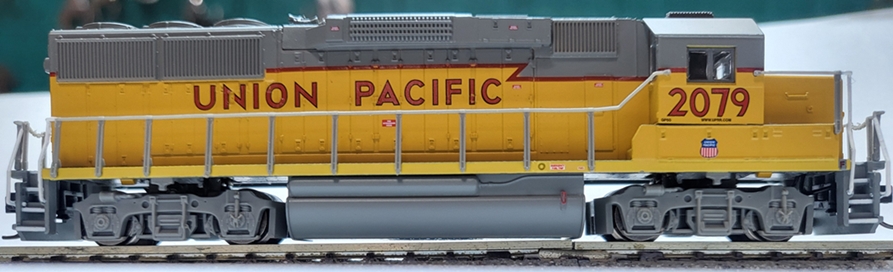
Performance on this new version is most excellent, although I can't say that it's quite as perfect as the original Life-Like release. This one is plenty smooth and plenty quiet, but as gushed about above, the Life-Like version made no sound at all! Pulling power is adequate, with mine able to handle 30 assorted 40' freight cars through curves on level track. Slow speed creep is one-tie-at-a-time. The sound feature is decent. Sadly, the ditch lights are quite dim and barely visible in a fully lit room. Also, right out of the box mine had lots of issues with stalling, so I pulled off the truck sideframes to see if Atlas had applied wheel blackening to the axle wipers. And sure enough, they had -
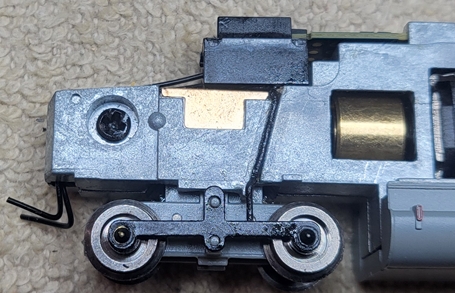
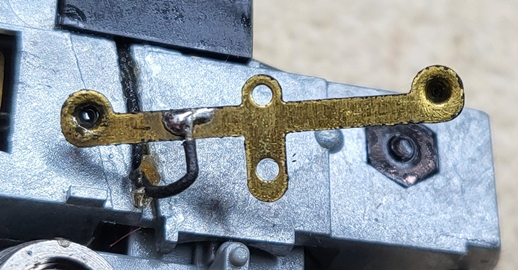
The somewhat hilarious part of this is that they did burnish the blackening off of the contact side. But of course, burnishing is not going to clean out the dimples wherein the axles actually seat. So, I had to get in there with an Exacto blade and clean them out myself. And joy of joys, during this whole procedure I managed to pull off a couple of the truck wires, which then required re-soldering (grouse, grumble). All in all a fairly painful and annoying procedure.
So, at the end of the day the Atlas model is a decent enough runner, but I think there are enough annoyances here to keep it out of the "A" category (especially as compared to the original Life-Like release).
Trivia - this GP60 shell is reportedly a good fit for the Fox Valley GP60 chassis (although not vice versa).
To remove the shell, stick a couple of toothpicks (or small screwdrivers or whatever) between the shell and the chassis and spread the sides outwards a bit. The shell should lift up and off at that point. Unfortunately, the "just grab the shell and wiggle it up and off" method doesn't really work on these models - the shell is held in place pretty solidly by four dimples in the chassis.
Grade: A (for the Life-Like and Walthers versions) and B (for the Atlas version)